
 Community Development Agency

 GENERAL PLAN, SPECIFIC PLANS, AND ORDINANCES
- ZONING
- CODE ENFORCEMENT
- RESIDENTIAL DESIGN GUIDELINES AND STANDARDS
- LAND USE PLANNING FORMS
- BOARDS AND COMMISSIONS
- MEETINGS
- PENDING LAND USE PROJECTS
- CEQA PROJECTS
- SURFACE MINE PERMITS
- CLIMATE CHANGE AND SUSTAINABILITY
- WASTE PROGRAM
- ALTAMONT OPEN SPACE
- QUICK LINKS
- ARCHIVE
Trees and the Urban Forest in Unincorporated Alameda County

¿Habla español?
Haga clic aquí para ver este sitio web en español: El Bosque Urbano del Condado de Alameda.

Benefits of Trees
Trees provide many economic, social, and environmental benefits to Alameda County's unincorporated communities.
In urban areas, the presence of trees can raise property values, lower energy bills, decrease pollution, cool down buildings and pavement, increase urban wildlife habitat, and support healthier and more connected neighborhoods.
In rural areas, trees help prevent soil erosion, decrease storm runoff and flooding, increase native biodiversity, provide shade and cooling, and enhance natural scenic beauty.
Trees are also allies in the County's response to climate change, sequestering carbon as they grow, decreasing energy use and associated greenhouse gas emissions, and making neighborhoods more resilient to climate change hazards like extreme heat and flooding.
Tree Regulations in Unincorporated Alameda County
Street Trees
Street trees and other trees in unincorporated Alameda County's public right-of-way are protected by the Tree Ordinance (number O-2016-66) and overseen by the Public Works Agency's Tree Program. Please visit PWA's website to learn more about this ordinance and the right-of-way Tree Program.
Trees on Private Property
There are currently no countywide ordinances regulating trees on private property in unincorporated Alameda County. Generally, property owners in unincorporated Alameda County can plant, prune, and remove trees on their own property without a permit from the County.
In the unincorporated community of Fairview only, the Views and Sunlight Ordinance (number O-2012-07) recognizes a property owner's right to existing views and access to sunlight from unreasonable obstruction by tree growth and outlines a process to restore those views or sunlight when they become blocked.
Tree Canopy Cover in Unincorporated Alameda County
Tree canopy is the layer of leaves, branches, and stems of trees that cover the ground when viewed from above. A dense forest may have a tree canopy percentage of nearly 100, while areas with very few trees may have tree canopy of less than 5%. The environment in unincorporated Alameda County includes diverse ecosystems with inherently different tree canopy potential, ranging from open grasslands to oak woodlands to urbanized areas.
In urban areas, differences in tree canopy cover can reflect differences in wealth and health. Lower-income neighborhoods and communities of color often experience significantly less tree cover as a result of unfair housing and development policies. When an urban neighborhood has fewer trees, it can lead to hotter temperatures and worse health outcomes for the people who live there. To help promote community health and wellness, the Alameda County Board of Supervisors set a goal of achieving at least 20% urban tree canopy cover in the County's urban areas by 2050 as part of the 2024 Environmental Justice Element of the County General Plan.
The table below shows tree canopy cover percentages in Alameda County and the unincorporated area overall, and in each of the named unincorporated communities.
| AREA | TREE CANOPY COVER |
|---|---|
| Alameda County (all) | 18% |
| Alameda County (unincorporated) | 22% |
| Ashland | 11% |
| Castro Valley | 20% |
| Castro Valley (southwestern census tracts) | 14% |
| Cherryland | 13% |
| Fairview | 32% |
| San Lorenzo | 12% |
| Hayward Acres (a census tract within San Lorenzo) | 9% |
| Sunol | 28% |
SOURCE: East Bay Regional Parks Alameda and Contra Costa Fine Scale Vegetation Map "Alameda and Contra Costa County Canopy Cover" Version: 4/1/2023 https://experience.arcgis.com/experience/0827ad50653b48b891ce891dc34620c4/.
2026-2028 Urban Forest Planning Project
In 2025, Alameda County was awarded a $685,000 grant through CAL FIRE's Urban and Community Forestry Grant program to fund a comprehensive urban forest planning project for the county's urban unincorporated communities of Ashland, Castro Valley, Cherryland, Fairview, Hayward Acres, and San Lorenzo. This project is a critical first step toward achieving the County's goal (identified in the 2024 Environmental Justice (EJ) Element) of achieving at least 20% urban tree canopy coverage in the County's unincorporated Environmental Justice (EJ) Priority Communities by 2050, and includes development of a long-range Unincorporated Urban Forest Plan, a public tree inventory for street trees and park trees, and a workforce development program to train future urban foresters. The project began in March 2026 and is expected to be completed by March 2028.
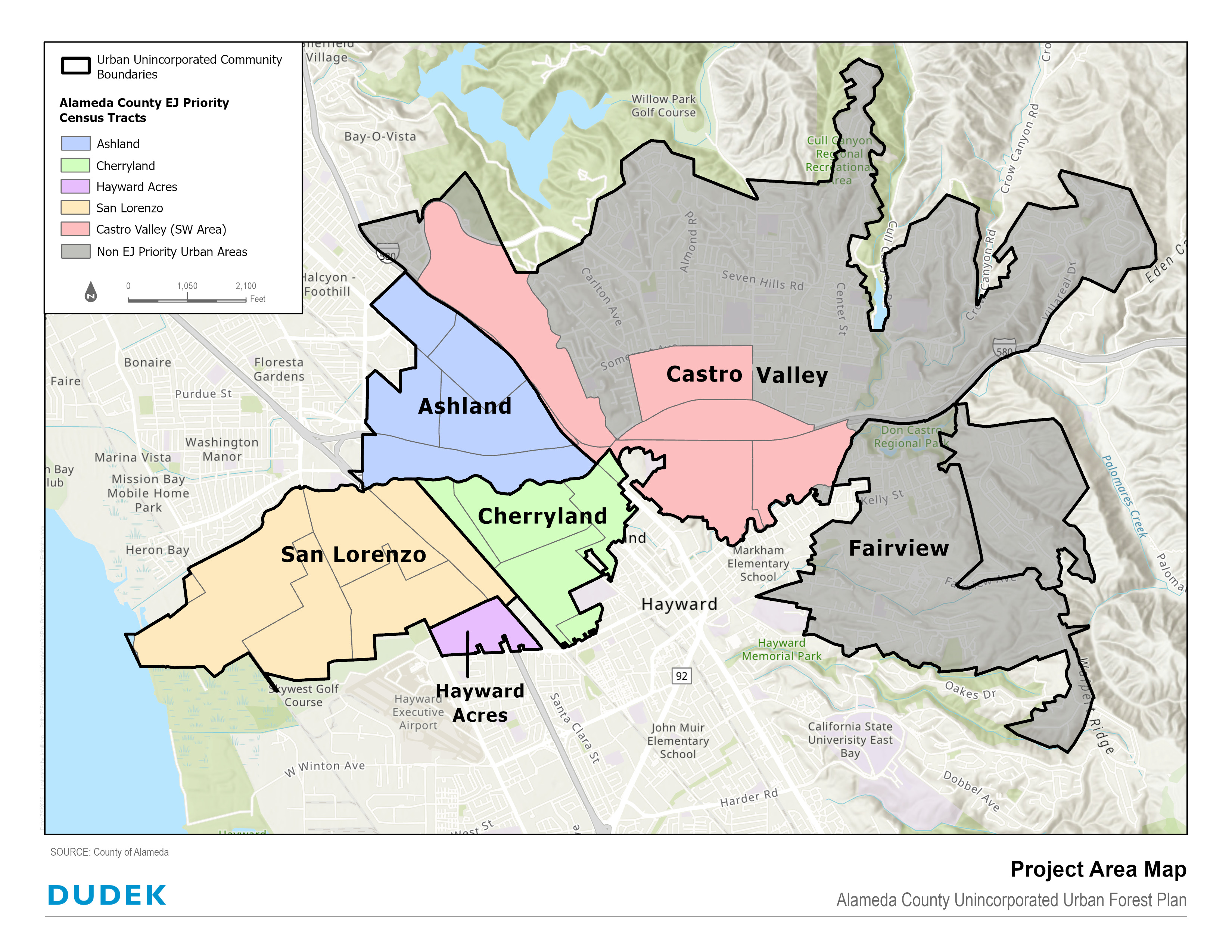
Urban forest planning project area
Unincorporated Urban Forest Plan (UUFP)
The Unincorporated Urban Forest Plan (UUFP) will be a roadmap to guide the County's investments in the growth, maintenance, and protection of the unincorporated-area urban forest, ensuring that all communities can share equitably in the benefits of trees. The UUFP will analyze information about current conditions, such as existing tree programs and ordinances, fire risk, and canopy distribution, and propose a course of action to help the County reach its urban forestry goals. Adoption of the plan is anticipated by early 2028.
Public Tree Inventory
The County is conducting a tree inventory that will document the current size, species, condition, and other key attributes of every street tree and HARD park tree in the urban unincorporated communities. The tree inventory will provide important data for the UUFP process, and is a tool for responsible planting, growth, and maintenance of the urban forest. The tree inventory is expected to be completed by the end of 2026, and tree inventory data will be made available to the public via an interactive map.
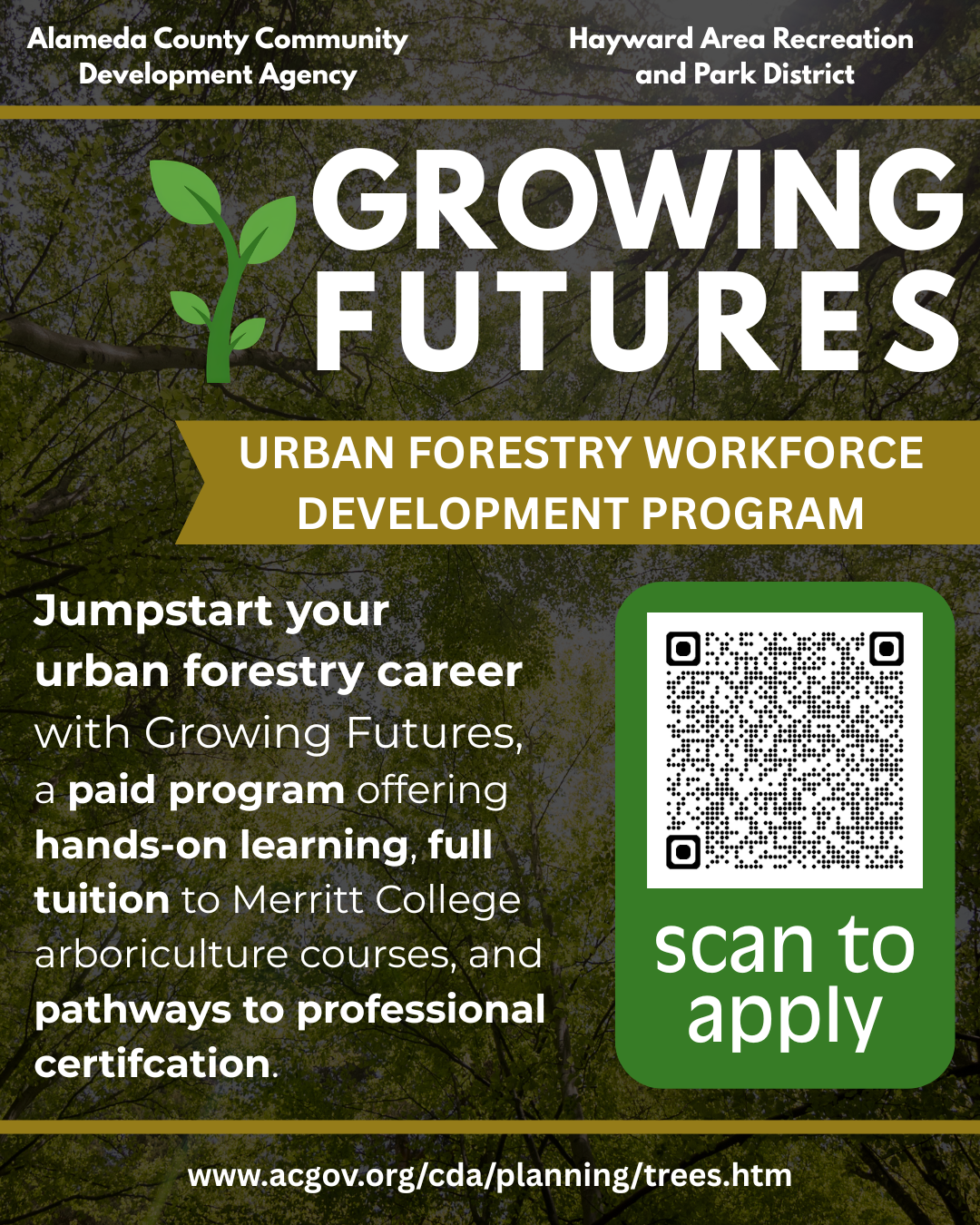
"Growing Futures" Workforce Development Program
The Growing Futures workforce development program connects local residents to local public agency urban forestry jobs through hands-on learning, shadowing opportunities, and classroom work. The program is managed by the Hayward Area Recreation and Park District (HARD) in partnership with Alameda County and Merritt College's Landscape Horticulture program. If you are interested in participating, please fill out the application. If you have any additional questions, please contact Thomas Omolo at HARD: omot@haywardrec.org.
Get Involved
There are many ways to get involved and share your input during the development of the UUFP. Join our listserv for announcements about these events and opportunities:
- Community workshops
- Pop-up events
- Public hearings and presentations
- Online engagement opportunities, including surveys
- Tree Advisory Group (TAG). The TAG is an intergenerational group of community volunteers working alongside County staff and technical advisors to guide the development and implementation of the UUFP. All TAG positions are currently filled, but new members may be admitted on a rolling basis as needed.
Project Funding
Funding for this Project was provided by the USDA Forest Service Urban and Community Forest Program via the Inflation Reduction Act, as administered by the California Department of Forestry and Fire Protection (CAL FIRE) Urban and Community Forestry Program.

